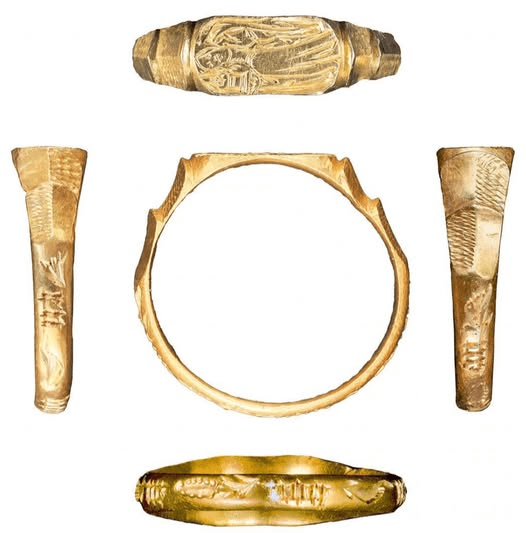
A complete gold finger ring (iconographic) of medieval date (c.1400-1500).
The hoop of the ring is D-shaped in cross-section and widens at the shoulders to meet the flat-topped, sub-rectangular bezel. The bezel is engraved with a representation of St Barbara holding a miniature tower. She is wearing drapery, and there is a palm frond *symbol of martyrdom) or palm branch (the symbol of St Barbara) in her right hand. The shoulders are imbricated, with two sub-rectangular steps that have a slightly concave surface, and a central ridge divides the shoulders into four panels. The upper right and lower left panels are filled with incised oblique lines, while the remaining panels are undecorated. Below the shoulders, the loop gently tapers and is decorated on both sides with a sprig or leaf.
Underneath the sprig is black lettering script. The lower portion of the hoop is decorated with a frond and palm branch on either side of engraved black letter text. The inscription reads ‘en bon an ’ (‘In a Good Year’, also sometimes translated as ‘For the New Year’). In the recesses of the letters ‘o’ and ‘n’ for ‘bon’ and the ‘n’ of ‘an’ are traces of white enamel. The internal band is undecorated and uninscribed.
Measurements: diameter: 19.98 mm; length: 19.18 mm; width (at bezel): 5.62 mm; thickness (lower loop): 1.26 mm; weight: 2.78g
Anglo-Saxon Gold Ring…
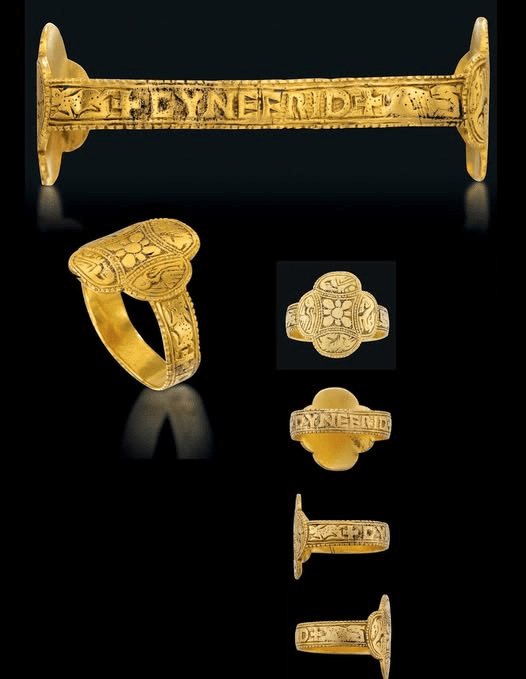
Lobed quatrefoil design, each of the four panels decorated with a stylised creature, which, from the top, appear to be a hare or rabbit, a bird of prey, a swan and a dog; at the centre, there is a flowerhead with eight petals.
The hoop with lettering reading CYNEFRID between two crosses and flanked by a stylised deer and a hare on each shoulder.
The decoration and lettering would have stood out from the niello background (now mostly lost), mid-9th century, 23.2 by 19.0 mm
Sold at Christie’s for £37,250 in 2010
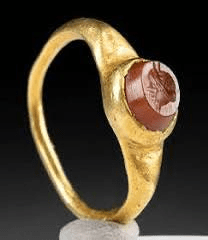
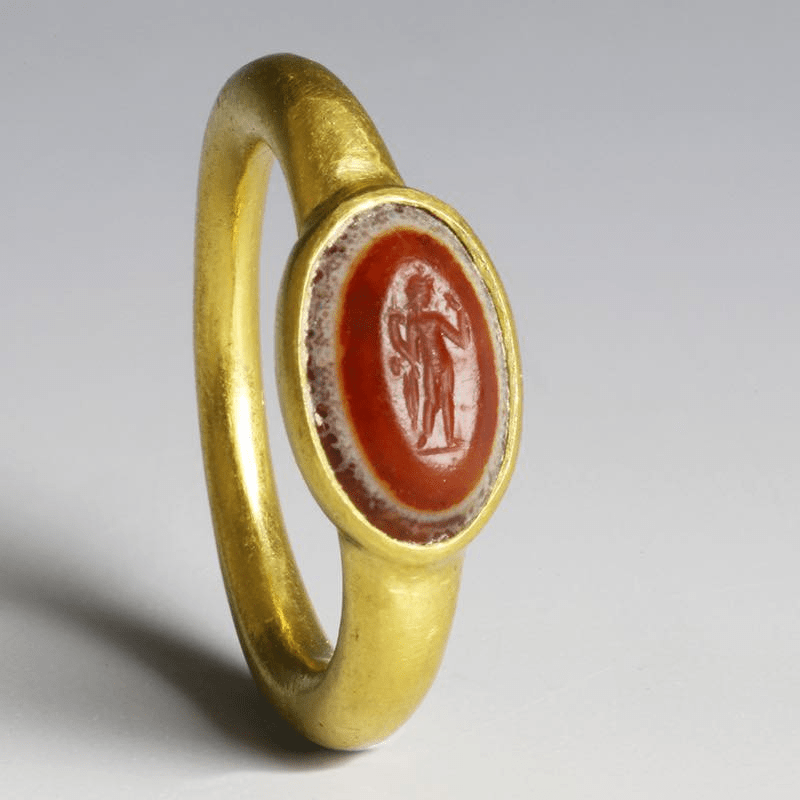
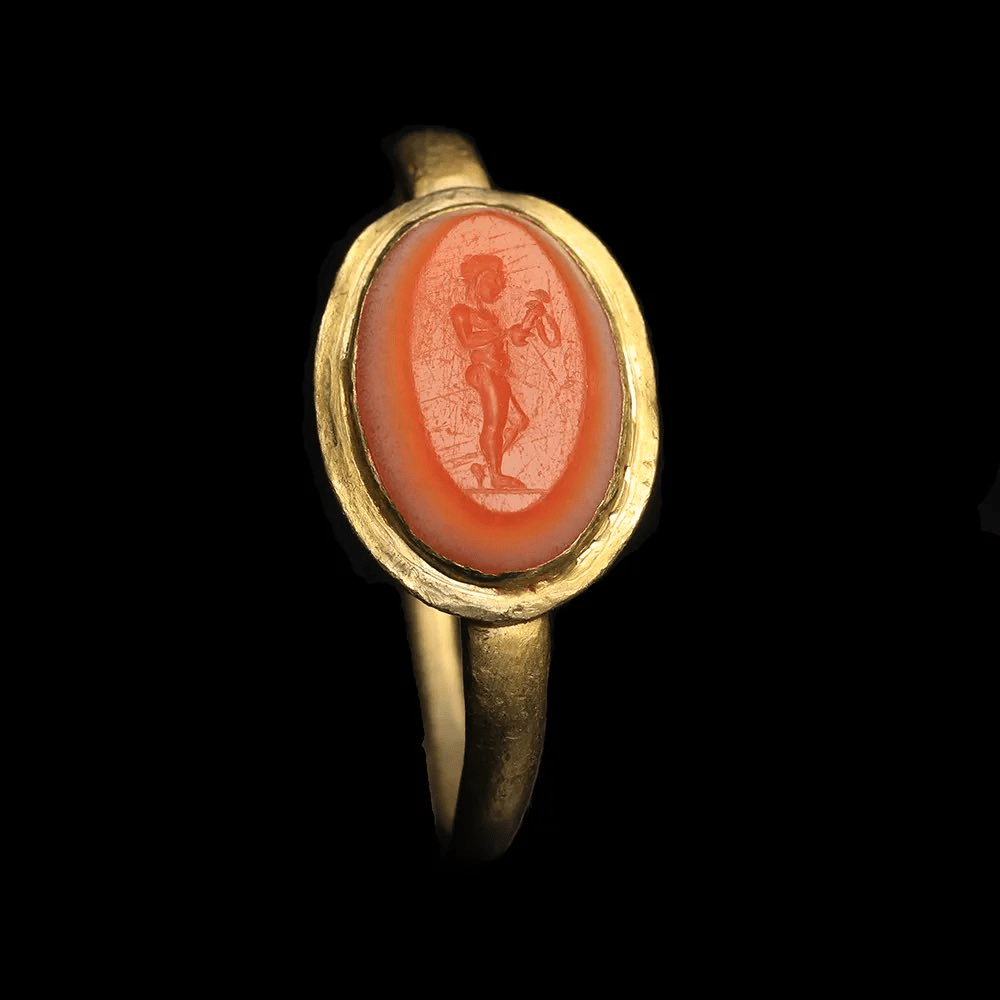
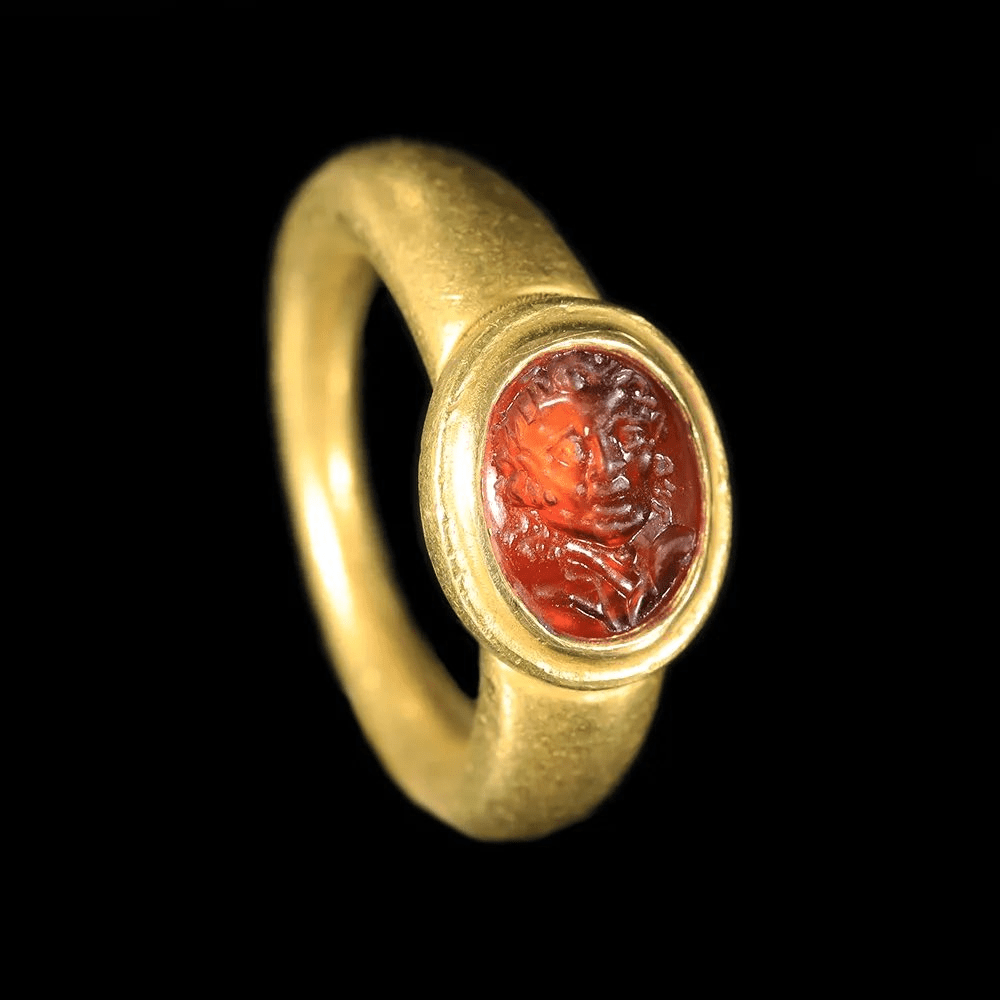
4 – Roman Rings from the Soil of England…
Have you ever wondered why most staircases in medieval castles were built to be extremely narrow and spiral clockwise?
Since medieval castles were built mainly as fortifications, the stairs were designed to make it extremely difficult for enemy fighters to make their way up the stairs. As most Soldiers were right-handed, they would have to surround every curve of the inner wall before attempting to attack, inevitably exposing themselves in the process. The clockwise snail ladder also allowed defenders to use the inner wall as a partial shield and allowed them to easily swing their weapon without being hindered by the curvature of the outer wall.
The stairs were also intentionally poorly lit and unevenly built, making it even harder for attackers to gain some sort of balance or momentum during their struggle to capture the castle.
Source:: Historical Videos

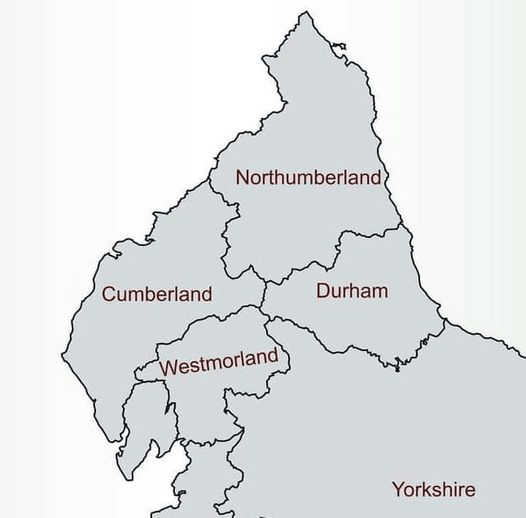
The great northern giveaway!! Englands northern frontier on the move
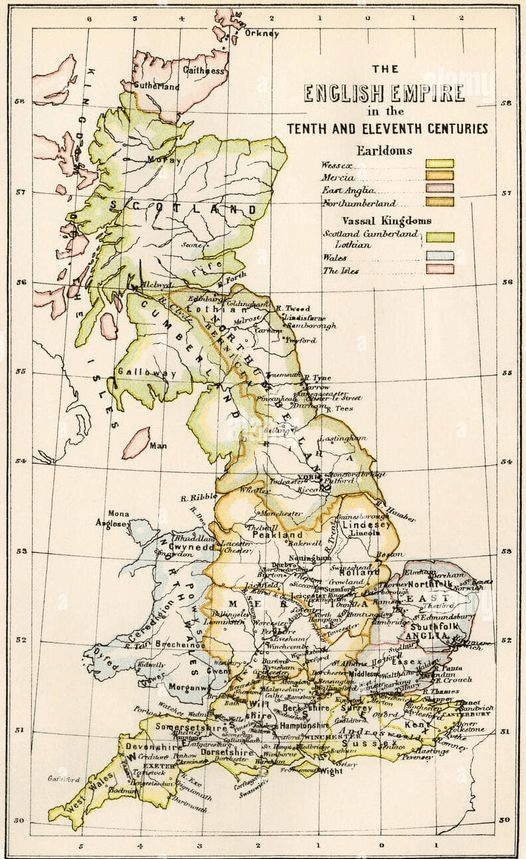
The northern frontier of England was well established by the first three Norman kings. It was thrown into reverse by the anarchy of King Stephen and the disputed succession. King David had pledged his oath to support the daughter of Henry I, the Empress Matilda. He also used anarchy to take lands and roll back the frontier. King David invaded England in 1136 and twice in 1138. He took Carlisle, the western anchor of the frontier which he then used as a base to exert control over Cumberland and Westmorland. King Stephen was forced to revive the earldom of Northumbria and grant it to Henry of Scotland, the son of King David.
Kind David now had control over the eastern and western reaches of the frontier pushing the border back to Newcastle.
David entertained the young Henry FitzEmpress in 1149 and extracted an oath from the future King of England, granting that when he became king, Henry would hand over Newcastle and all the land from the river Tweed to the Tyne. It was the Great North Giveaway!!
Cumberland, Westmorland and Northumberland were all to be given away. The frontier rolled back south.
When Henry became king of England in 1154, he was faced with a choice to break his oath to the king of Scotland or abandon a vast portion of the North. Henry chose to break his oath. At Chester in 1157, the new King of England put it to the new King of Scotland that “the king of England ought not to be defrauded of so large a part of his kingdom, nor would he suffer to be deprived of it”.
Cumberland, Westmorland and Northumberland were restored to the English crown. Henry restored his Sheriffs back in the said shires and restored the frontiers to his grandfather’s day.
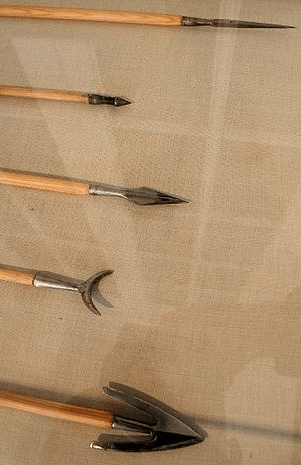
Medieval arrowheads – from armour piercing, to pinning a Knight to his horse. The English Longbow of Legend. It took years of practice to become a truly effective archer. The training being actively encouraged from the age of 8 years old. Master bowmen were highly prized and to this end King Edward III made practicing archery compulsory on Sundays after church and on Feast days.
Every village was required to have its own archery range where the villagers could practice. These villages located around the English borders produced a good supply of experienced archers used to dealing with the frequent skirmishes with the Scottish and Welsh.
Such training from a young age took a physical toll on the archer. As an archer myself, pulling a far lighter draw-weight bow than supposedly would have been used in a medieval battle, it is possible to see differences between the muscle development on my right and left side.
The same, more extreme deformities were found on the skeletons recovered from the Mary Rose shipwreck. With these archers showing signs of significant over development on one side of their bodies, twisted spines, and bones in the wrist.
That is not to say these men were all hobbling around but rather had adapted gradually after years of practice. It is also often suggested that bow draw weights were between 80 to 130lb.