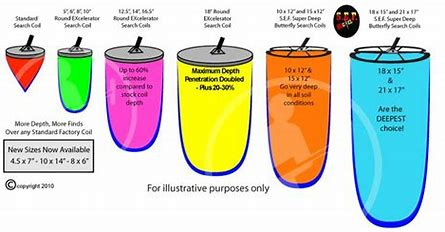
In the beginning…
You must optimise the Swing of your metal detector to Maximise the surface coverage & depth, & this is so important for new detectorists like Mark to understand and practice…
Many people lose depth by the incorrect way they use the detector but more importantly how they swing the detector…
To maintain as much ground cover you need to keep the coil close to the ground by using a smooth side-to-side motion that covers a semi-circular area in front of you, keeping the coil of your metal detector as close to the ground as possible, ideally, it would be about an inch or less above the surface, or as close as the vegetation / ground allows you to without bashing the coil too much, whilst maintaining a steady arc as you sweep slowly from left to right and vice versa, making sure you cover the ground with a swing and pace that suits you to reduce fatigue that is caused by the incorrect swing, also using the coil wrong you lose ground cover and as shown here your hardly detecting the ground as you go forward…

The Importance of using the proper Swing Technique when out in the field…
To make any outing with a metal detector successful many factors play their own individual part, one of the most important things to master is the art of keeping your coil parallel to the ground, an important technique many have not conquered, when out on a rally just stand back and observe, it does not matter if you have an expensive metal detector or a cheap beginners metal detector, it is only as good as the operator, it’s not how capable your metal detector is if you’re only just detecting the ground at the bottom of your swing…
By not doing a correct swing you are wasting your time, energy, & effort, this is the often overlooked yet critical piece of detecting & that is how you master the technique you use when swinging your metal detector… an interesting side note, if you practice turning the edge of your coil DOWNWARDS at the end of every sweep this helps in maintaining a near perfect parallel swing to the ground…
Practice makes Perfect…
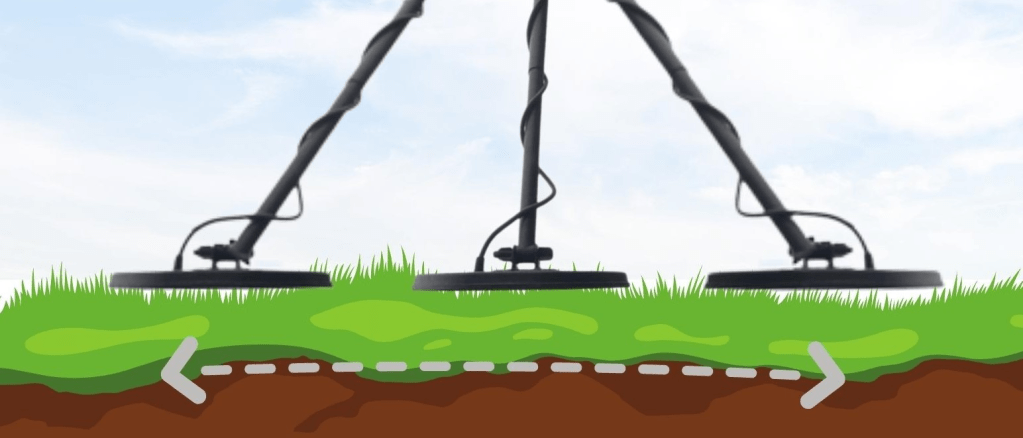
By not using the proper swing technique, you are affecting the depth capabilities of your metal detector, which in turn affects the depth at which your metal detector can get a signal from coins & artefacts, also the area you cover is about 20% of each swing; you can easily lose 80% effectiveness by a lazy or incorrect swing…
This was posted in another group, and I thought it would be a shame not to share here…
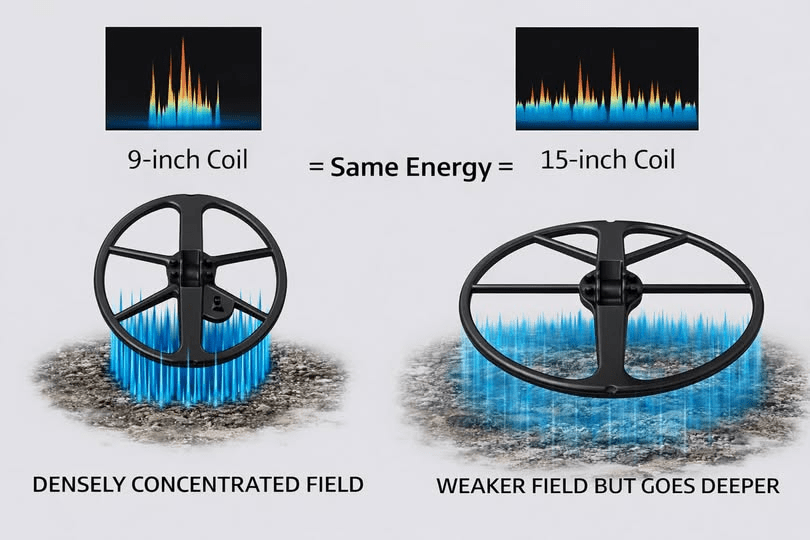
A larger coil projects a broader, less concentrated EM field. That’s why it couples well with large masses at depth, but it will never interrogate a small or awkward target with the same intensity as a smaller coil. Especially the 9-inch — its diameter vs power hits the sweet spot. All those who use it know that.
Most of our land is quite tough going. Well, it is here in the SW UK.
A coin on edge presents a tiny cross-section. A smaller coil with higher flux density can still couple; a big coil spreads the same transmit energy wider, so the return signal is diluted.
In a field with iron, a smaller coil isolates the coin from the nail. The big coil sees both together, averages them, and the coin response vanishes.
Resolution doesn’t just mean “separating two targets.” It means resolving the fine detail of a single weak target’s response from the ground matrix. Bigger coil = poorer resolution, always.
And about “perfect soil” — sure, on a clean patch or clean test garden, the loss is less obvious. But that’s not detecting reality. In 99% of the ground we hunt, mineralisation + stubble + random ferrous means resolution is king.
The idea that a 15” can “see small just as well” is probably not the best advice, as it’s so rarely a field truth.
So yes — a 15” coil gives depth on large deep conductors. But on single hammered coins, cut quarters, or a Roman bronze lying awkwardly, it will always be less efficient than a smaller loop. No amount of “perfect conditions” can change the underlying physics.
More ground coverage? Per swing yes, but overall – probably not. Well, not unless you have arms like Arnie in 1986. The double sweeping stops, those little cheeky after checks stop – because it’s all effort. And chances are, a much shorter session.
I agree, it’s an important piece of the arsenal, but in my experience, it only comes out for hoard hunting in good soil
A question posted on the page (1) DETECTING IN DEPTH – Technical Forum | this Facebook page talks about, how the coils actually work…
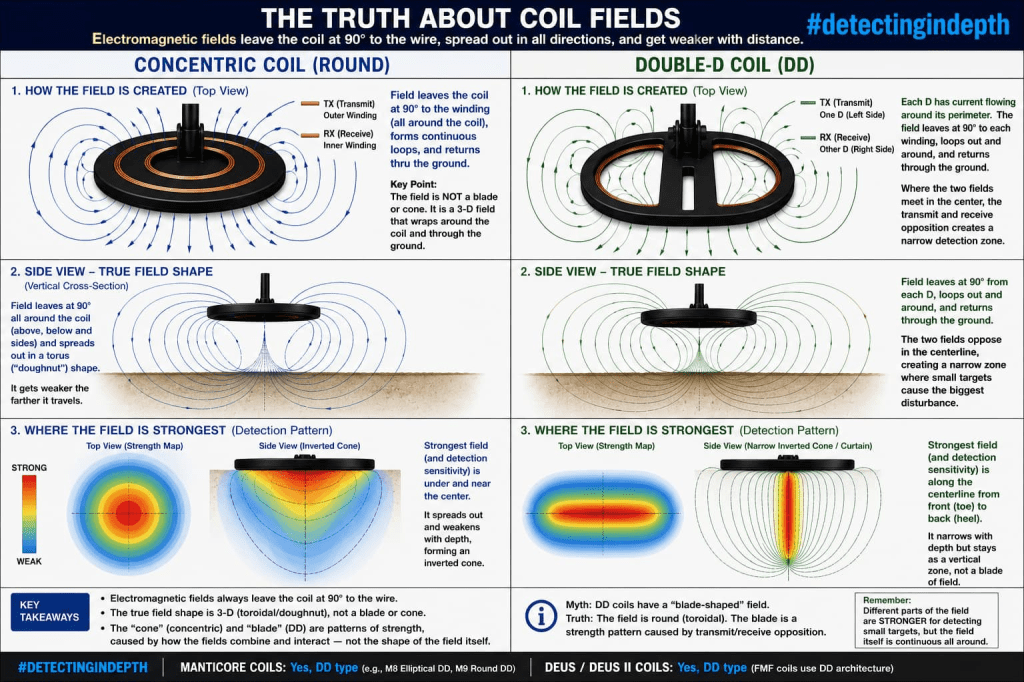
Not sure I understand fully. With a DD coil, I infer from the explanation that the EM field is two doughnuts whose fields intensify in the centre of the coil. But in the graphic, it states one coil is transmitting, and the other receives. What am I missing?
Think of the DD centre line not as two doughnuts joining to make a stronger field, but as the zone where the transmitted field and the receive coil are best positioned to detect a target disturbance. Arguably, a receive coil would not have the same ‘doughnut’ as it’s listening and not emitting (so much less strong), but you can argue that the receive field pattern will be broadly similar, hence it makes sense to show it diagrammatically …
So, how true is the older but widely used graphics ? If we compare the new with the old, the only difference is modern AI making things look more technologically sound and proving the point…




Leave a comment